
Bebington Archers
About Archery
A (very) brief history
Flint arrowheads from approximately 20,000 years ago indicate that humans were using archery for hunting long before wooden flat bows were found in the Somerset Levels which dated back to circa 2690 BC.
By the Anglo-Saxon/Norman period, archery had become crucial in warfare, especially with the introduction of the yew longbow after the Normal Conquest and dominated battlefields for centuries until gunpowder became the weapon of choice from the 15th Century onwards.
Despite this, our relationship with the bow continued and archery as a sport grew in popularity. Fast forward to 1844 and Grand National Archery Meetings began, with the Grand National Archery Society (now Archery GB) forming just over the water in Liverpool in 1861.
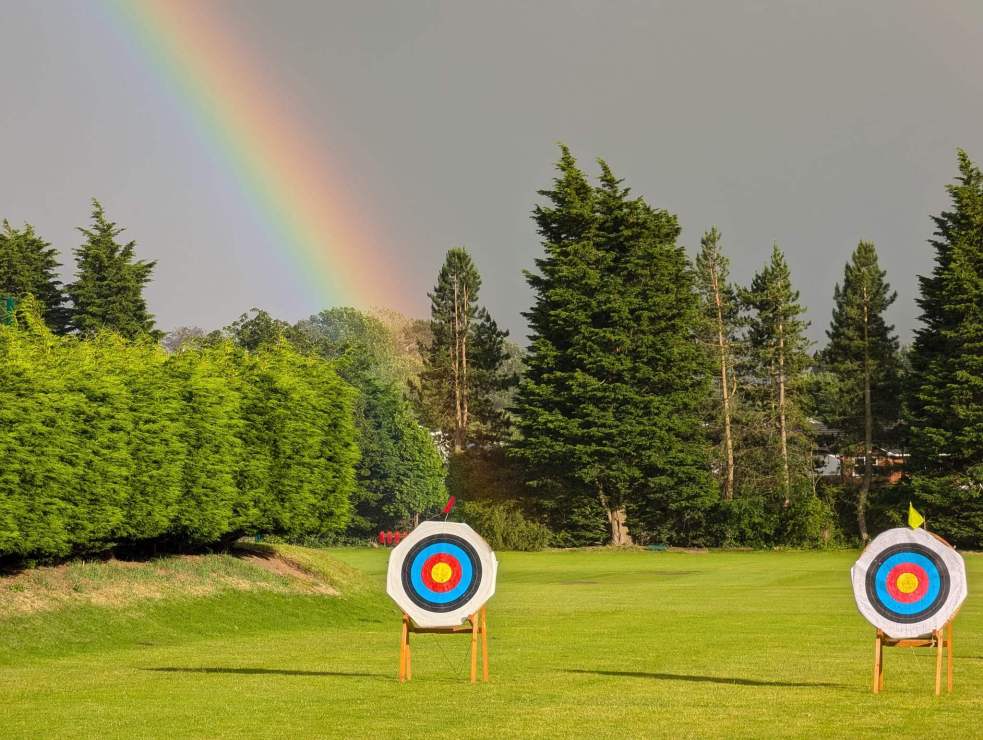
Target Archery
There are a number of disciplines in archery: target, field, 3D, flight, run, ski, para, and indoor. Bebington Archers is a target archery club.
Target archery involves shooting arrows at stationary circular targets placed at set distances. The targets are divided into coloured rings — yellow, red, blue, black, and white — each representing different scores, with the highest points awarded for hitting the gold centre.
Competition distances vary depending on the type of bow:
• Recurve archers typically shoot up to 70 metres.
• Compound archers generally compete at 50 metres.
• Barebow and longbow archers often shoot between 50 and 70 metres, though in some events longbow archers may shoot as far as 90 metres.
Types of Bow
There are four main types of bow; recurve, compound, longbow, and barebow, all of which you will see in the various disciplines.
At the moment, the recurve bow is the only kind of bow used in Olympic archery but that will change with the debut of compound archery at the Los Angelese 2028 Olympic Games.
Longbows are the most historically accurate and traditional kind of bow in the UK and are still, generally, made of wood.
The recurve bow is the modern equivalent of the traditional bows. They are fitted with non-magnifying sights and stabilisers and can shoot arrows at speeds of more than 200 kph. Whilst they were historically made of wood, modern bows are built using materials such as aluminium or carbon fibre in the riser (handle) and laminated carbon fibre and carbon foam in the limbs.
Barebow archery uses a recurve bow but without stabilisers or sights.
Compound bows are designed for maximum efficiency and power and use a system of pulleys and cables. They can be made of aluminium or carbon fibre, whilst the limbs are usually made from fibreglass. Archers can use magnifying sights and mechanical release aids.
Archery Competitions
In target archery, rounds are classified into two main types: metric and imperial. Archers are free to choose whichever round they prefer, regardless of the category it is traditionally associated with. For example, adults may shoot a junior round, though they may not be eligible for competition awards in that category.
The key consideration is selecting a round that suits your preference and comfort level. After all, archery is supposed to be fun!
Rounds in archery competitions.
Competitions are organised so that you shoot a set number of arrows at specified distances at a specified target face. This is known as a round. The types of rounds are split into Archery GB and World Archery Rounds.
Archery GB rounds (imperial)
Traditional British rounds, these tend to use 5-zone scoring and are governed by the Archery GB Rules of Shooting. The target is divided into five coloured scoring zones and points (9, 7, 5, 3, 1).
World Archery rounds (metric)
These rounds use 10-zone scoring. All scoring indoors uses 10-zone scoring, although Xs are not used. Everyone shoots the same distance; 30 metres, 25 metres or 18 metres. For compound archers, only the very inner 10 is scored as 10. For non-compound archers, the central two areas are scored as 10.
Scoring
Scores are recorded on a score sheet with the highest scoring arrow recorded first. An arrow that does not score is called a miss and is marked as ‘M’ on the score sheet. Once written down, the values can only be changed by judge and then only before the arrows have been removed from the target.
Outdoor arrows are shot in ‘ends’ of six or three arrows (depending on the round or distance begin shot) and indoor arrows are generally shot in groups of three with every six arrows shot being called an end.
Awards in archery competitions
Most competitions have their own medals, trophies or certificates, and details of these can be found on the entry form. Normally the competition will award 1st, 2nd and 3rd, depending on the number of entries in each category.
There may also be additional prizes, for example best gold or worst white, which will usually be judged on one random end of shooting and you won’t know which end until you’ve shot it!
Six Gold End awards
The Six Gold End badge is an Archery GB award given to people who get six golds at one of the two longest shooting distances. For example, for men it is achievable at 100 yards, 80 yards, 90 metres, or 70 metres. (There is also a Three Gold End award which is available to Longbow archers at the same distance.) If you get a six (or three) gold end, then ask the Organiser for a claim form, complete it and send it to the Archery GB Membership Services office.
Archery GB Rose awards
These can only be claimed for York, Hereford, or Bristol competition rounds, which have Rose Award Status, as indicated on the entry form. Rose awards are used for shooting certain scores (for recurve and compound archers), and range from White level for a score over 800 to Purple level for a score over 1250.
You need to achieve the score shooting the round that is appropriate to your age and gender. If you achieve a score, complete the claim form with the organiser, who will submit it to Archery GB on your behalf with a copy of the score sheet and the competition results.
From 1 April 2025, Rose awards will be available for 50+ archers shooting the Bristol II (Ladies) or Hereford/Bristol 1 (Gentleman) at tournaments that have been accorded Rose Award Status. Claims must be made via the tournament organiser on the day of the competition.
WA Star Awards
As with Rose Awards these are awarded for shooting a certain score at World Record Status competitions. They are achievable for recurve, compound, senior, master, or cadet rounds. Full details of the scores can be found in the World Archery Rules of Shooting.
For WA Star rounds they range from White level for a score of 1000 to Purple level for a score of 1400.